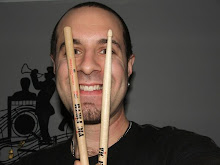
Hey Everyone,
I work with a GB (General Business) band regularly. In addition to the excellent pay, we get other perks as well. Check it out:
Tuesday, November 18, 2008


Monday, November 10, 2008
Schtudio Groovin'
I did a recording session last weekend for singer extraordinaire Erin Vulgamore (with Andy Martin producing). Had a great time. Here's some footage:
Thursday, November 6, 2008
Friday, August 29, 2008
Mastery Part 4: Mental Clarity
Hey everyone, many apologies for the lack of posts recently. Today's article examines the next step in achieving Mastery: Mental Clarity.
Forewarning: this post is what some might consider 'deep'. I will talk about some eastern philosophies that might seem a little "out there". At times you may need to re-read some passages...I encourage this. I guarantee that you will not understand everything right away. This stuff is intense, but stick with it because I can say without a doubt that these concepts WILL help you become the best drummer you can be.
As you may have already gathered from my past articles on the subject, achieving Mastery requires alignment of many different variables, most of which reside in the mental space. As such, we need to free up our minds so that we can focus 100% of our concentration on realizing Mastery. This is why mental clarity is so important.
Do you think about things all the time? Do you find yourself thinking about more than one thing at a time and getting stressed as a result? Is it a challenge for you to focus on one thing for an extended period of time? Do you feel 'scattered' or 'disorganized'?
If you answered yes to any of these questions, you and I have something in common: our minds have a tendency to race and we're constantly thinking too much. What I find interesting is the more I talk to people about this the more I realize that the majority of people in our society suffer from this affliction.
This is no way to live, for our lives happen right now, in the present moment.
Zen Buddhists use the term 'Mindfulness' to describe a way of life that focuses on living in the moment. The Vietnamese monk Tich Knat Hanh is one of the foremost authorities on this philosophy and I like how he explains it:
If we're constantly thinking about multiple things while living out lives, we're missing out on life.
How does this affect us as drummers/musicians? I'll explain this by telling you all a little story.
There once was this young, energetic, naive, cocky drummer. He was barely 16 years old and he had been hired to play multiple percussion for a community theater production. This kid had skills and experience for someone his age. He was a great reader and knew his way around the multi-percussion set-up that surrounded him in the pit.
After several rehearsals, he had the gig nailed. Opening night went without a hitch and the show received a standing ovation from the capacity crowd. Life couldn't have been better.
The next day our hero was at school and he had an altercation with one of his classmates. He was sent to the Principal's office where they called his parents and his guidance counselor. Later that day he had to meet with them all and a heated discussion regarding his recent behavior ensued. He was warned several times that if he didn't 'shape up his attitude' his future would suffer severe consequences.
Our hero spent the rest of the afternoon thinking about this meeting AND about his future. He wandered home from school completely preoccupied. The last thing on his mind was the theater gig he had that night. He got home, had a silent dinner with his parents, and then drove to the theater.
Several minutes before the hit, his mind was still far away from the music he was about to play. As the lights dimmed around the sold-out theater, the conductor raised his hands to cue the intro tympani roll that began the Overture. However, our hero wasn't paying attention. His mind was where it had been all day, recounting the tough love he received at school. The conductor waved his hands madly and our hero finally 'awoke' from his mindlessness and began to perform the overture.
Later on during the performance, our hero's mind wandered off yet again and he missed several sound effect cues. He even threw off the lead actor by missing his entrance into a song.
At the end of the night, the conductor AND director was furious at our hero. Some of the actors glared at him while he walked out of the theater. It was a bad scene all around.
This experience compounded our hero's negative and mindless state. For the rest of the production, he continued to make mistakes and his attitude went south. After the closing night he had lost the respect of his conductor and fellow musicians. Needless to say, he didn't get any future gigs from these people!
If you haven't already guessed it, the hero in this story was me. It was a tough experience but I learned a very important lesson: leave your problems at home when playing a gig. Music should be a release from them.
Relating the story to our mindfulness philosophy, I had lost the 'moment' and I was living in the past. My thoughts were consumed with something that had already happened so I couldn't focus on what was happening in the moment. As a result I made mistakes...big ones.
Why think/worry about something that's already happened? It's done, finished, over-with. Get on with life.
The other thing that happened was my mindlessness triggered a downward spiral. I had the gig nailed...Mastered even! However, after the 'unpleasantness' at school, my mind was preoccupied, causing the first bad night. Between what had happened at school and what had happened that night, my mind was overwhelmed and I never recovered. I lost the moment and the mistakes piled-up. By the end of the week-long production my attitude was terrible and everything blew up in my face.
So now that I've exemplified how bad mindlessness can be, let's talk about some techniques I use to maintain mindfulness and subsequent mental clarity. The first step is to understand and incorporate some simple philosophies into life:
1. Focus on the moment. What are you doing right now? Reading this article, right? Are you thinking about anything else? Stop!
2. Eliminate time-based thoughts. In other words, if your thoughts are on past or future events, stop and focus on the moment. This doesn't mean you can never think about something that's happened in the past; I think it's important to analyze experiences and learn from them. Thinking/planning for the future is important too. The point here is not to do this while you're busy performing a task. If you need to think about the past or future, do this, but ONLY this. Don't do it while you're playing a gig!
3. Open your mind and your heart to everything life throws at you. Acceptance is the key to happiness and mental clarity. Resistance causes mental conflict.
I combine these philosophies with 2 daily practices: meditation and exercise.
Exercise is an excellent mind-cleanser, especially highly vigorous exercise. I find that if I'm working my butt off at the gym or on a long run, I can't help but think about one thing and one thing only: getting that last rep or completing that last mile. When I'm grunting under the weight of a barbell or sucking air while in a full sprint, I am truly in the moment. I'm not thinking about my overdue car insurance bill or the bad gig I had last week or the argument I had with a friend last night.
Meditation is based more on mental clarity through relaxation, and it is something that takes time and dedication to learn properly. However, it is EXTREMELY effective and it will change your life in many ways. For more information on meditation, here are some great resources:
"The Miracle of Mindfulness" - meditation manual by Tich Nhat Hanh
http://www.how-to-meditate.org/
Cambridge Insight Meditation Center
In closing, remember that we can never find our true potential towards Mastery without complete mental clarity. Mastery requires every bit of focus and concentration we possess. Embrace the philosophy of mindfulness, exercise regularly and practice meditation. I guarantee you'll find a deeper level of concentration, not to mention inner peace.
Until next time, I mindfully wish you Mastery!
Forewarning: this post is what some might consider 'deep'. I will talk about some eastern philosophies that might seem a little "out there". At times you may need to re-read some passages...I encourage this. I guarantee that you will not understand everything right away. This stuff is intense, but stick with it because I can say without a doubt that these concepts WILL help you become the best drummer you can be.
As you may have already gathered from my past articles on the subject, achieving Mastery requires alignment of many different variables, most of which reside in the mental space. As such, we need to free up our minds so that we can focus 100% of our concentration on realizing Mastery. This is why mental clarity is so important.
Do you think about things all the time? Do you find yourself thinking about more than one thing at a time and getting stressed as a result? Is it a challenge for you to focus on one thing for an extended period of time? Do you feel 'scattered' or 'disorganized'?
If you answered yes to any of these questions, you and I have something in common: our minds have a tendency to race and we're constantly thinking too much. What I find interesting is the more I talk to people about this the more I realize that the majority of people in our society suffer from this affliction.
This is no way to live, for our lives happen right now, in the present moment.
Zen Buddhists use the term 'Mindfulness' to describe a way of life that focuses on living in the moment. The Vietnamese monk Tich Knat Hanh is one of the foremost authorities on this philosophy and I like how he explains it:
"Anyone can wash the dishes in a hurry, try this for a change:While washing the dishes one should only be washing the dishes, which means that while washing the dishes one should be completely aware of the fact that one is washing the dishes. At first glance this might seem a little silly: why put so much stress on a simple thing? But that's precisely the point. The fact that I am standing there and washing these bowls is a wondrous reality. I'm being completely myself, following my breath, conscious of my presence, and conscious of my thoughts and actions. There's no way I can be tossed around mindlessly like a bottle slapped here and there on the waves.
There are two ways to wash the dishes. The first way is to wash the dishes in order to have clean dishes and the second way is to wash the dishes in order to wash the dishes. If while we are washing dishes, we think only of the cup of tea that awaits us, thus hurrying to get the dishes out of the way as they were a nuisance, then we are not 'washing the dishes to wash to wash the dishes.' What's more we are not alive during the time we are washing the dishes....If we can't washes the dishes, chances are we won't be able to drink our tea either."
If we're constantly thinking about multiple things while living out lives, we're missing out on life.
How does this affect us as drummers/musicians? I'll explain this by telling you all a little story.
There once was this young, energetic, naive, cocky drummer. He was barely 16 years old and he had been hired to play multiple percussion for a community theater production. This kid had skills and experience for someone his age. He was a great reader and knew his way around the multi-percussion set-up that surrounded him in the pit.
After several rehearsals, he had the gig nailed. Opening night went without a hitch and the show received a standing ovation from the capacity crowd. Life couldn't have been better.
The next day our hero was at school and he had an altercation with one of his classmates. He was sent to the Principal's office where they called his parents and his guidance counselor. Later that day he had to meet with them all and a heated discussion regarding his recent behavior ensued. He was warned several times that if he didn't 'shape up his attitude' his future would suffer severe consequences.
Our hero spent the rest of the afternoon thinking about this meeting AND about his future. He wandered home from school completely preoccupied. The last thing on his mind was the theater gig he had that night. He got home, had a silent dinner with his parents, and then drove to the theater.
Several minutes before the hit, his mind was still far away from the music he was about to play. As the lights dimmed around the sold-out theater, the conductor raised his hands to cue the intro tympani roll that began the Overture. However, our hero wasn't paying attention. His mind was where it had been all day, recounting the tough love he received at school. The conductor waved his hands madly and our hero finally 'awoke' from his mindlessness and began to perform the overture.
Later on during the performance, our hero's mind wandered off yet again and he missed several sound effect cues. He even threw off the lead actor by missing his entrance into a song.
At the end of the night, the conductor AND director was furious at our hero. Some of the actors glared at him while he walked out of the theater. It was a bad scene all around.
This experience compounded our hero's negative and mindless state. For the rest of the production, he continued to make mistakes and his attitude went south. After the closing night he had lost the respect of his conductor and fellow musicians. Needless to say, he didn't get any future gigs from these people!
If you haven't already guessed it, the hero in this story was me. It was a tough experience but I learned a very important lesson: leave your problems at home when playing a gig. Music should be a release from them.
Relating the story to our mindfulness philosophy, I had lost the 'moment' and I was living in the past. My thoughts were consumed with something that had already happened so I couldn't focus on what was happening in the moment. As a result I made mistakes...big ones.
Why think/worry about something that's already happened? It's done, finished, over-with. Get on with life.
The other thing that happened was my mindlessness triggered a downward spiral. I had the gig nailed...Mastered even! However, after the 'unpleasantness' at school, my mind was preoccupied, causing the first bad night. Between what had happened at school and what had happened that night, my mind was overwhelmed and I never recovered. I lost the moment and the mistakes piled-up. By the end of the week-long production my attitude was terrible and everything blew up in my face.
So now that I've exemplified how bad mindlessness can be, let's talk about some techniques I use to maintain mindfulness and subsequent mental clarity. The first step is to understand and incorporate some simple philosophies into life:
1. Focus on the moment. What are you doing right now? Reading this article, right? Are you thinking about anything else? Stop!
2. Eliminate time-based thoughts. In other words, if your thoughts are on past or future events, stop and focus on the moment. This doesn't mean you can never think about something that's happened in the past; I think it's important to analyze experiences and learn from them. Thinking/planning for the future is important too. The point here is not to do this while you're busy performing a task. If you need to think about the past or future, do this, but ONLY this. Don't do it while you're playing a gig!
3. Open your mind and your heart to everything life throws at you. Acceptance is the key to happiness and mental clarity. Resistance causes mental conflict.
I combine these philosophies with 2 daily practices: meditation and exercise.
Exercise is an excellent mind-cleanser, especially highly vigorous exercise. I find that if I'm working my butt off at the gym or on a long run, I can't help but think about one thing and one thing only: getting that last rep or completing that last mile. When I'm grunting under the weight of a barbell or sucking air while in a full sprint, I am truly in the moment. I'm not thinking about my overdue car insurance bill or the bad gig I had last week or the argument I had with a friend last night.
Meditation is based more on mental clarity through relaxation, and it is something that takes time and dedication to learn properly. However, it is EXTREMELY effective and it will change your life in many ways. For more information on meditation, here are some great resources:
"The Miracle of Mindfulness" - meditation manual by Tich Nhat Hanh
http://www.how-to-meditate.org/
Cambridge Insight Meditation Center
In closing, remember that we can never find our true potential towards Mastery without complete mental clarity. Mastery requires every bit of focus and concentration we possess. Embrace the philosophy of mindfulness, exercise regularly and practice meditation. I guarantee you'll find a deeper level of concentration, not to mention inner peace.
Until next time, I mindfully wish you Mastery!
Wednesday, August 13, 2008
Drumming and Athletics
You may have noticed in several of my articles how I often consider drumming to be a very athletic endeavor. Well, here's a bona fide scientific study that supports my claims:
http://news.bbc.co.uk/2/hi/health/7518888.stm
http://news.bbc.co.uk/2/hi/health/7518888.stm
Sunday, August 10, 2008
Mastery Part 3: Self Analysis
Hi everyone, today's post is part three in my 'Mastery' series: Self Analysis.
In my last post I explained how to practice mindfully in lieu of achieving Mastery. One of the themes in that article was how to develop a practice regimen. Self Analysis is an excellent and accurate method of creating and continually modifying your regimen.
Moreover, I highly recommend that you try to use the following concepts regularly in lieu of remaining on a steady path of improvement. Remember, the mindful experience of lifelong growth as a musician is what it's all about. As the old saying goes, life is a journey, not a destination.
Before I get into specific techniques for self analysis, or what I also refer to as self actualization, I want to talk a little bit about the psychology surrounding the practice. Whenever humans start to analyze themselves, this creates a mental process that can loop out of control if we're not careful. Our culture is largely based on a reactive perspective and as such I suspect that most Americans spend the majority of their time thinking in this mode. Think about it; do you know many people that spend a significant amount of time practicing techniques that help move them towards self-actualization? I don't. I see most people going through the motions of their lives, acting out their daily routine, with little or no cognizance of the experience. Years go by and they wonder where the time went.
When we enter into the realm of self actualization, we turn our focus inward, and for many people this is a very new and sometimes uncomfortable experience. It takes time to become comfortable with this way of thinking. We start to realize things about ourselves that are not often consciously considered, and usually the first things we notice aren't positive.
In my personal experience, when I started to spend significant amounts of time thinking in this manner, I eventually entered into a lengthy state of depression. I became aware of many things about my drumming that I didn't like, and I was overwhelmed with the need to make all sorts of changes immediately. The problem was, changing many of these things would take time and the prospect of having to spend a year or more working on one facet of my skill set on the drums was difficult to accept. Eventually my thoughts on the matter turned into subjective statements about my general abilities on the instrument (or lack thereof). It took me a long time to dig my way out of that hole, but I learned 2 very important lessons:
1. Always Remain Objective
2. Compartmentalize Your Analysis
In order to prevent a downward spiral, you absolutely must remain objective when in the midst of self analysis. It is much easier said than done; we're only human and as such it is impossible to completely separate emotions from experiences. There are going to be times when you're going to feel completely bummed-out. It is unavoidable. However, it is possible to keep things in perspective and remain predominantly objective.
First of all, never play the comparison game. While it is human to compare ourselves to others, there is nothing to gain from the experience. What ultimately matters is our own level of musicianship and our progress as it relates to our goals and aspirations. On an objective level, when we use others as a means to gauge our own level of proficiency, we are left with an analysis that is unrelated to said goals and aspirations. Subjectively, making statements about how superior someone's level of proficiency is to our own will only serve to deflate and defeat what confidence and motivation we possess.
Watching a master drummer can and should be an excellent source of inspiration and motivation, but I've found that this only happens when I refrain from playing the comparison game.
Another thing that helps keep things in perspective is to always remind yourself of your strengths and play to them frequently. For example, if you play a great blues shuffle, take lots of blues gigs! If you excel at playing rudiments, join a drum & bugle corps. The point is, put yourself in situations that will rely on your strengths most often. Sure, I'm a huge advocate for also putting yourself out of your comfort zone in lieu of improving, but if you do this ALL the time, you'll spend too much time on your weaknesses and you'll forget your strengths. The idea is to balance the two.
Balance equals perspective, and this will serve to keep your thoughts objective.
Compartmentalizing your analysis simply means to keep your thoughts/notes organized and to avoid making generalizations. In other words, if analysis inspires motivation to improve something specific, leave it at that. Don't allow this motivation to then inspire broad feelings of inadequacy.
Here's a more specific example. While listening to a tape of a recent performance, I noticed that my time rushed a little bit while playing a specific groove. The proper way to move forward from this is to only associate my rushing time with that specific groove and practice it accordingly. The wrong thing would be to start making generalizations about my time, i.e. saying things like 'My time sucks...I always rush'. My time doesn't always rush...only when I play that particular groove!
See my point?
In addition to the concepts discussed above, you'll find that if you follow the techniques I'm about to explain regarding specific analysis practices, these will also help you keep things objective and compartmentalized.
So just how do I analyze my performances? I use two different methods:
1. Journaling
2. Audio and Video Documentation
Keeping a detailed journal of every performance experience is absolutely paramount. Practice sessions, gigs, whatever...I journal it all. I try to include as much detail as I can recall. In this way I can document everything permanently. This offers me many advantages. First of all, as we discussed earlier, it gives me perspective. When I'm feeling crappy after a bad gig or challenging practice session, I can always go back and read about one of my better performances. My journal also provides me a way to document my progress. If I practice something consistently and mindfully and enter journal entries after each practice session, I can go back and read each entry, noting the progress made. Often times when working on difficult material progress is slow and it's tough to notice. This method helps me realize that I am making consistent progress, and it also helps me realize when I'm not, prompting me to alter my approach and try something different.
I try to format my journal entries in a specific manner so that when I go back and read past entries I can quickly find the information I'm looking for. Here's an example: a recent entry after a gig:
The headings I chose aren't necessarily appropriate for you, but the idea is to orient each journal post in an organized manner. Notice that I try to include as much detail as possible, and I also include notes regarding equipment changes. Everything is important, so write it all down!
Usually when I'm refining my practice regimen, I'll look through my past journal entries and note the information under the "Lessons" heading. These are things that I feel need improvement and as such they are eventually added to my regimen.
Do yourself a favor and start a journal today. I used to keep a written journal but I recently changed over to electronic format. I created a new blog here on blogspot.com and set it to private. Give it a try!
The second method of analysis, audio and video documentation, will give you incredible amounts of detailed information unlike any other source. In fact, it is even more accurate than your journal since journaling relies on memory (I don't know about you but my memory sucks!). When you document you performances as they happen, everything is included.
For audio, I use an M-Audio MicroTrack:

Check out their website here.
I usually throw it behind my drumkit and hit record before each set. Or, if I'm playing a larger venue, I'll ask the FOH sound engineer if I can place it somewhere on his mixing console or on an equipment rack. Most of the time these guys are happy to run it for you, and sometimes they'll even connect it directly to the board and I'll get a nice 'board mix' recording of the concert (only do this if your drums are properly miked...otherwise you'll get a nice recording of everyone but yourself!).
For video, I use a Flip Video Ultra:

Check out their website here.
This thing is so cool!! It's the same size as a regular digicam, takes great video, and the audio quality is surprisingly good. I try to shoot gigs but it's often difficult to find a spot for the camera, so lately I've used it mostly to record my practice sessions. I'll often set it up close to my hands so I can get a real nice look at my technique.
Ok, so once you get all this audio and video, what do you do with it? The first thing is to organize it all. I always use filenames that include the date and a short description of the performance. For example, I have an audio file that's called 081008_Practice.mp3. 081008 is the date (August 10 of 2008) and 'Practice' tells me it is a recording of a practice session. For gigs, I usually name them similarly; date followed by an abbreviated band name followed by 'LIVE' or 'REH' so I know if it's a gig or a rehearsal. I use the same naming convention for videos.
Then I save them on my laptop in different folders. I have an 'audio' and a 'video' folder, and within those are sub-folders for live shows, rehearsals, and practice sessions.
Once you've organized, time to analyze!
I keep a written log of notes that I use while listening/viewing. Whenever I notice something I'll pause the recording and write down my thought along with the location of the recording. This way I can go back later and revisit to further analyze. Some of these notes serve the simple purpose of increasing my self-actualization while others can serve as a means to help refine my practice regimen.
Don't forget to have fun with all this stuff. I often catch some classic moments, especially on gigs. It's nice to have these moments documented; sometimes when I have free time I'll listen/watch and just enjoy the entertaining manner by which I've made an ass of myself onstage (it happens more than I care to admit).
To sum-up:
1. Keep your analysis within the realm of objectivity and compartmentalize your thoughts.
2. Use journaling, audio and video as a means to document your performances.
3. Keep the information you're gathering organized, and use this information to help you stay on the path towards self-actualization as well as a tool for practice regimen refinement.
4. Share the lighter moments with your bandmates!
The path to Mastery is easier to navigate when your level of self actualization is consistently high. Use these methods I have described and remember to follow a process-oriented mindset throughout.
In my last post I explained how to practice mindfully in lieu of achieving Mastery. One of the themes in that article was how to develop a practice regimen. Self Analysis is an excellent and accurate method of creating and continually modifying your regimen.
Moreover, I highly recommend that you try to use the following concepts regularly in lieu of remaining on a steady path of improvement. Remember, the mindful experience of lifelong growth as a musician is what it's all about. As the old saying goes, life is a journey, not a destination.
Before I get into specific techniques for self analysis, or what I also refer to as self actualization, I want to talk a little bit about the psychology surrounding the practice. Whenever humans start to analyze themselves, this creates a mental process that can loop out of control if we're not careful. Our culture is largely based on a reactive perspective and as such I suspect that most Americans spend the majority of their time thinking in this mode. Think about it; do you know many people that spend a significant amount of time practicing techniques that help move them towards self-actualization? I don't. I see most people going through the motions of their lives, acting out their daily routine, with little or no cognizance of the experience. Years go by and they wonder where the time went.
When we enter into the realm of self actualization, we turn our focus inward, and for many people this is a very new and sometimes uncomfortable experience. It takes time to become comfortable with this way of thinking. We start to realize things about ourselves that are not often consciously considered, and usually the first things we notice aren't positive.
In my personal experience, when I started to spend significant amounts of time thinking in this manner, I eventually entered into a lengthy state of depression. I became aware of many things about my drumming that I didn't like, and I was overwhelmed with the need to make all sorts of changes immediately. The problem was, changing many of these things would take time and the prospect of having to spend a year or more working on one facet of my skill set on the drums was difficult to accept. Eventually my thoughts on the matter turned into subjective statements about my general abilities on the instrument (or lack thereof). It took me a long time to dig my way out of that hole, but I learned 2 very important lessons:
1. Always Remain Objective
2. Compartmentalize Your Analysis
In order to prevent a downward spiral, you absolutely must remain objective when in the midst of self analysis. It is much easier said than done; we're only human and as such it is impossible to completely separate emotions from experiences. There are going to be times when you're going to feel completely bummed-out. It is unavoidable. However, it is possible to keep things in perspective and remain predominantly objective.
First of all, never play the comparison game. While it is human to compare ourselves to others, there is nothing to gain from the experience. What ultimately matters is our own level of musicianship and our progress as it relates to our goals and aspirations. On an objective level, when we use others as a means to gauge our own level of proficiency, we are left with an analysis that is unrelated to said goals and aspirations. Subjectively, making statements about how superior someone's level of proficiency is to our own will only serve to deflate and defeat what confidence and motivation we possess.
Watching a master drummer can and should be an excellent source of inspiration and motivation, but I've found that this only happens when I refrain from playing the comparison game.
Another thing that helps keep things in perspective is to always remind yourself of your strengths and play to them frequently. For example, if you play a great blues shuffle, take lots of blues gigs! If you excel at playing rudiments, join a drum & bugle corps. The point is, put yourself in situations that will rely on your strengths most often. Sure, I'm a huge advocate for also putting yourself out of your comfort zone in lieu of improving, but if you do this ALL the time, you'll spend too much time on your weaknesses and you'll forget your strengths. The idea is to balance the two.
Balance equals perspective, and this will serve to keep your thoughts objective.
Compartmentalizing your analysis simply means to keep your thoughts/notes organized and to avoid making generalizations. In other words, if analysis inspires motivation to improve something specific, leave it at that. Don't allow this motivation to then inspire broad feelings of inadequacy.
Here's a more specific example. While listening to a tape of a recent performance, I noticed that my time rushed a little bit while playing a specific groove. The proper way to move forward from this is to only associate my rushing time with that specific groove and practice it accordingly. The wrong thing would be to start making generalizations about my time, i.e. saying things like 'My time sucks...I always rush'. My time doesn't always rush...only when I play that particular groove!
See my point?
In addition to the concepts discussed above, you'll find that if you follow the techniques I'm about to explain regarding specific analysis practices, these will also help you keep things objective and compartmentalized.
So just how do I analyze my performances? I use two different methods:
1. Journaling
2. Audio and Video Documentation
Keeping a detailed journal of every performance experience is absolutely paramount. Practice sessions, gigs, whatever...I journal it all. I try to include as much detail as I can recall. In this way I can document everything permanently. This offers me many advantages. First of all, as we discussed earlier, it gives me perspective. When I'm feeling crappy after a bad gig or challenging practice session, I can always go back and read about one of my better performances. My journal also provides me a way to document my progress. If I practice something consistently and mindfully and enter journal entries after each practice session, I can go back and read each entry, noting the progress made. Often times when working on difficult material progress is slow and it's tough to notice. This method helps me realize that I am making consistent progress, and it also helps me realize when I'm not, prompting me to alter my approach and try something different.
I try to format my journal entries in a specific manner so that when I go back and read past entries I can quickly find the information I'm looking for. Here's an example: a recent entry after a gig:
Synopsis:
Wedding gig on Nantucket with Freestyle.
Positives:
-Grooves were very solid; one of our singers even commented on them after the gig
-I stretched out my fills a little more than usual and still kept the feel solid.
-I tried a different stick - Vic Firth 5A Extremes. I like them more than the 5B's. They're slightly leaner making them a little lighter and the tones from the drums aren't quite so "thudy".
-I finally replaced the batter head on the kick. It has much more tone and attack and the response from the beater is livelier and easier to control during faster rhythms.
Lessons:
-I sweated a lot and my left pinky finger was irritated at the end of the night. Some grip analysis is needed.
Other:
I feel so much more loose these days. I think it is a combination of having my technique in better shape and approaching the gig with more of an open heart and mind.
The headings I chose aren't necessarily appropriate for you, but the idea is to orient each journal post in an organized manner. Notice that I try to include as much detail as possible, and I also include notes regarding equipment changes. Everything is important, so write it all down!
Usually when I'm refining my practice regimen, I'll look through my past journal entries and note the information under the "Lessons" heading. These are things that I feel need improvement and as such they are eventually added to my regimen.
Do yourself a favor and start a journal today. I used to keep a written journal but I recently changed over to electronic format. I created a new blog here on blogspot.com and set it to private. Give it a try!
The second method of analysis, audio and video documentation, will give you incredible amounts of detailed information unlike any other source. In fact, it is even more accurate than your journal since journaling relies on memory (I don't know about you but my memory sucks!). When you document you performances as they happen, everything is included.
For audio, I use an M-Audio MicroTrack:

Check out their website here.
I usually throw it behind my drumkit and hit record before each set. Or, if I'm playing a larger venue, I'll ask the FOH sound engineer if I can place it somewhere on his mixing console or on an equipment rack. Most of the time these guys are happy to run it for you, and sometimes they'll even connect it directly to the board and I'll get a nice 'board mix' recording of the concert (only do this if your drums are properly miked...otherwise you'll get a nice recording of everyone but yourself!).
For video, I use a Flip Video Ultra:

Check out their website here.
This thing is so cool!! It's the same size as a regular digicam, takes great video, and the audio quality is surprisingly good. I try to shoot gigs but it's often difficult to find a spot for the camera, so lately I've used it mostly to record my practice sessions. I'll often set it up close to my hands so I can get a real nice look at my technique.
Ok, so once you get all this audio and video, what do you do with it? The first thing is to organize it all. I always use filenames that include the date and a short description of the performance. For example, I have an audio file that's called 081008_Practice.mp3. 081008 is the date (August 10 of 2008) and 'Practice' tells me it is a recording of a practice session. For gigs, I usually name them similarly; date followed by an abbreviated band name followed by 'LIVE' or 'REH' so I know if it's a gig or a rehearsal. I use the same naming convention for videos.
Then I save them on my laptop in different folders. I have an 'audio' and a 'video' folder, and within those are sub-folders for live shows, rehearsals, and practice sessions.
Once you've organized, time to analyze!
I keep a written log of notes that I use while listening/viewing. Whenever I notice something I'll pause the recording and write down my thought along with the location of the recording. This way I can go back later and revisit to further analyze. Some of these notes serve the simple purpose of increasing my self-actualization while others can serve as a means to help refine my practice regimen.
Don't forget to have fun with all this stuff. I often catch some classic moments, especially on gigs. It's nice to have these moments documented; sometimes when I have free time I'll listen/watch and just enjoy the entertaining manner by which I've made an ass of myself onstage (it happens more than I care to admit).
To sum-up:
1. Keep your analysis within the realm of objectivity and compartmentalize your thoughts.
2. Use journaling, audio and video as a means to document your performances.
3. Keep the information you're gathering organized, and use this information to help you stay on the path towards self-actualization as well as a tool for practice regimen refinement.
4. Share the lighter moments with your bandmates!
The path to Mastery is easier to navigate when your level of self actualization is consistently high. Use these methods I have described and remember to follow a process-oriented mindset throughout.
Tuesday, July 15, 2008
Mastery Part 2: Mindful Practice
Today I'll delve further into my concept of 'Mastery' by explaining a concept I call "Mindful Practice". This is a concept I first considered after reading a brilliant book by Kenny Werner called "Effortless Mastery" (check out his concepts here). I'll break down the concept into 2 basic areas:
1. How to Practice in the moment.
2. How to determine when mastery is achieved through practice.
First I would like to talk a moment about practicing. I always tell students that the best method is to develop a regimen and stick to it. To do this, 3 things that must be considered: planning, goal setting, and time management.
First you have to ask yourself, what do I want to learn/improve during my practice sessions? This can depend largely on your level of development. For beginners this is usually determined by a teacher. As one improves and masters the fundamentals, different paths can be taken. Perhaps a person has an interest to learn more about a specific style, so her practice regimen would accommodate that. Working professionals who have been playing for significant amounts of time also have a specific regimen style.
Whatever the specific material may be, it must relate to the person's development level AND interests. This is key. I remember when I was 10 years old I had a school band teacher who railed my technique and insisted that I only work on that and nothing else. I spent 6 months playing rudiments to a metronome. Sure my technique improved, but I also began to hate my teacher AND my instrument. When school finished my drums gathered dust for the entire summer.
This was ultimately counterproductive as my technique got sloppy due to no practice and when I got back to school the following year I sucked! Luckily I had a new band teacher though, and he kept things much more interesting by catering to my interests.
The moral of the story is that whether you're just starting out on the instrument or a touring pro, your practice sessions need to strike a balance between skill sharpening and new, interesting material.
One you determine the proper material to practice, you must develop goals and a plan for achieving them. Your goals should be set-up so that larger goals are broken down into smaller goals. For instance, one of my larger goals is to develop my double-kick technique such that my feet are as loose and fluid as my hands. I have broken down this goal into smaller goals: learn rudiments with my feet, play grooves left-footed, etc.
On top of it all there needs to be a strong element of time management. We all have busy lives and most of us can't afford the luxury of spending 10 hours a day in the practice space, so we must use our time to the maximum efficiency. I recommend a strict schedule to any practice regimen. Again, this can be determined by your level of development and the included material.
For example, I have had students in the past whom could only practice an hour a day, so we would devise a schedule that managed everything right down to the minute. Other people who have more time might prefer a schedule that is a little more relaxed. Sometimes there's too much to fit into a single session so I'll spread it out over 2 sessions.
There are many ways to do this. Just remember that the end goal is to get at all the material you want to work on, and in a consistent manner.
To end my diatribe on proper practice regimens, here's a nice example: my current regimen.
Technique: 1-2 Hours
1. Stone Killer - trips @ 155bpm, 16th's at 125bpm
2. Various rudiments @ 120bpm
3. AOB Graph
4. Triple & Quadruple stroke rolls @ 100bpm
5. Dbl. strokes, 5-minutes nonstop @ varying volumes
6. Rudiments w/feet: para's, flams, dbl. strokes
Grooves: 1 hour
1. Rock, jazz, funk, latin @ 50bpm
2. Rock, jazz, funk, latin @ 100bpm
3. Rock, jazz, funk, latin @ 200bpm
4. Odd-time feels
5. Dbl. bass feels
Book Work: 1-2 hours
1. Portraits In Rhythm
2. Wilcoxon
3. Syncopation
Miscellany: 1-2 hours
1. Tunes to learn for upcoming gigs
2. Soloing
3. Record and analyze
I normally spend 4-5 hours in each session. Sometimes, depending on my schedule, I have to break this up between 2 sessions.
Ok, so you've got your regimen, a set plan, and your schedule. Time to hit the practice room and play, right?
That depends. When you're ready to start practicing, the first thing to do is clear your mind of all distractions. Mindful practice means focused practice. If you're stressed out or scattered mentally, you need to figure out how to calm yourself before beginning your practice session. There are several methods I use - meditation, exercise, rest. Whatever it takes to calm your mind and your body (WITHOUT the use of drugs or alcohol), I strongly suggest you do so before practicing. Otherwise you'll struggle to make progress and retain what you've worked on. Physically it will be a challenge to execute if your body is tense and stiff. Mentally you'll continue to lose focus and eventually you'll get frustrated and end your session without making any progress.
Another thing on distractions - your practice location needs to be free of them as well. Turn off your cell phone. Cover the windows. Remove anything that can interrupt your focus.
Once you start actually playing, always strive to be mindful. What that means to me is to be in the moment and pay attention to how things feel, sound and look. I'll pay attention to how my body feels noting any tension and altering my technique accordingly. I'll listen to how things sound and make small adjustments. I'll even watch myself play in a mirror and note my posture. If I could taste and smell my playing, I'd use those senses too. The point is that mindfulness equals being in the moment and taking it all in. The best way to do this is to use your senses to your advantage.
You'll take in a lot of information if you practice mindfully. Make sure to take notes and keep a journal.
So now that you've got hundreds of hours of mindful practice under your belt, how do you know that all of this stuff is working? How can you tell when you've mastered that crazy David Garibaldi groove in 7/8?
As I explained in my intro article, one of the characteristics of Mastery is when the conscious mind is not engaged to perform the psychological and/or physiological functions required to complete a task. Translating this into drumming, you're not consciously 'thinking' about the rhythmic executions performed around the drumkit.
Obviously one cannot consciously determine whether or not she is using her conscious mind to perform her instrument. It is possible to determine how 'easy' it is to execute something after a period of mindful practice but in my opinion this isn't precise enough to declare Mastery. In order to accurately determine whether or not you've attained this, a test must be performed.
I like to use a technique I created that's called the "Novel Test", named as such because of the steps involved as well as the fact that it's quite a novelty to watch someone do. You'll need several things to perform this test:
1. A tape recorder or other method of recording yourself
2. A novel that you've never read before
3. Your drumkit
4. Material you've mindfully practiced and feel may be Mastered
First, set up the recorder so that you can hear yourself talk while playing your drumkit. You might need to play at a softer volume to achieve this. Next, position the novel somewhere where it is easy to read while you play (I always place my music stand above my hi-hat so I just prop the book there). Ok, ready? Hit record and play through your material repeating it 5 times. Stop. Now start playing again, but this time start reading a paragraph in the book at the same time. Again, repeat the material 5 times and then stop.
Once finished, see how much of the book you remember. Try writing down character names, story details, etc. Also try and remember if you made any mistakes while playing through your material. Then, listen back to the recording. Pay close attention to your vocalizing of the words in the book. Follow along and see if you made any mistakes. Once the recording has finished, rewind it and listen back again, only this time pay attention to your execution on the drumset.
If you've performed the material and read the book precisely, this is as close an indication as you'll get that you've attained Mastery.
What exactly did this test do? In a nutshell, it distracted your conscious mind. Remember how I specified that the novel be something you've never read before? This is to ensure that none of it is memorized, thus requiring full conscious attention. As you perform this test several times you'll begin to notice that you'll remember less about playing the drums and more about reading the novel. This is a clear indicator that your conscious mind is engaged in reading, not drumming, which is exactly what we want.
Experiment with the concepts I've explained here. Everyone finds a slightly different approach and that's fine. Just remember that some of these techniques are difficult to execute at first but give it time. I challenge you to try this stuff out for a month. Keep a journal and record your progress. Once it becomes part of your practice style, these techniques will change the way you learn and progress.
Also, please get in touch and let me know how it is going for you!
1. How to Practice in the moment.
2. How to determine when mastery is achieved through practice.
First I would like to talk a moment about practicing. I always tell students that the best method is to develop a regimen and stick to it. To do this, 3 things that must be considered: planning, goal setting, and time management.
First you have to ask yourself, what do I want to learn/improve during my practice sessions? This can depend largely on your level of development. For beginners this is usually determined by a teacher. As one improves and masters the fundamentals, different paths can be taken. Perhaps a person has an interest to learn more about a specific style, so her practice regimen would accommodate that. Working professionals who have been playing for significant amounts of time also have a specific regimen style.
Whatever the specific material may be, it must relate to the person's development level AND interests. This is key. I remember when I was 10 years old I had a school band teacher who railed my technique and insisted that I only work on that and nothing else. I spent 6 months playing rudiments to a metronome. Sure my technique improved, but I also began to hate my teacher AND my instrument. When school finished my drums gathered dust for the entire summer.
This was ultimately counterproductive as my technique got sloppy due to no practice and when I got back to school the following year I sucked! Luckily I had a new band teacher though, and he kept things much more interesting by catering to my interests.
The moral of the story is that whether you're just starting out on the instrument or a touring pro, your practice sessions need to strike a balance between skill sharpening and new, interesting material.
One you determine the proper material to practice, you must develop goals and a plan for achieving them. Your goals should be set-up so that larger goals are broken down into smaller goals. For instance, one of my larger goals is to develop my double-kick technique such that my feet are as loose and fluid as my hands. I have broken down this goal into smaller goals: learn rudiments with my feet, play grooves left-footed, etc.
On top of it all there needs to be a strong element of time management. We all have busy lives and most of us can't afford the luxury of spending 10 hours a day in the practice space, so we must use our time to the maximum efficiency. I recommend a strict schedule to any practice regimen. Again, this can be determined by your level of development and the included material.
For example, I have had students in the past whom could only practice an hour a day, so we would devise a schedule that managed everything right down to the minute. Other people who have more time might prefer a schedule that is a little more relaxed. Sometimes there's too much to fit into a single session so I'll spread it out over 2 sessions.
There are many ways to do this. Just remember that the end goal is to get at all the material you want to work on, and in a consistent manner.
To end my diatribe on proper practice regimens, here's a nice example: my current regimen.
Technique: 1-2 Hours
1. Stone Killer - trips @ 155bpm, 16th's at 125bpm
2. Various rudiments @ 120bpm
3. AOB Graph
4. Triple & Quadruple stroke rolls @ 100bpm
5. Dbl. strokes, 5-minutes nonstop @ varying volumes
6. Rudiments w/feet: para's, flams, dbl. strokes
Grooves: 1 hour
1. Rock, jazz, funk, latin @ 50bpm
2. Rock, jazz, funk, latin @ 100bpm
3. Rock, jazz, funk, latin @ 200bpm
4. Odd-time feels
5. Dbl. bass feels
Book Work: 1-2 hours
1. Portraits In Rhythm
2. Wilcoxon
3. Syncopation
Miscellany: 1-2 hours
1. Tunes to learn for upcoming gigs
2. Soloing
3. Record and analyze
I normally spend 4-5 hours in each session. Sometimes, depending on my schedule, I have to break this up between 2 sessions.
Ok, so you've got your regimen, a set plan, and your schedule. Time to hit the practice room and play, right?
That depends. When you're ready to start practicing, the first thing to do is clear your mind of all distractions. Mindful practice means focused practice. If you're stressed out or scattered mentally, you need to figure out how to calm yourself before beginning your practice session. There are several methods I use - meditation, exercise, rest. Whatever it takes to calm your mind and your body (WITHOUT the use of drugs or alcohol), I strongly suggest you do so before practicing. Otherwise you'll struggle to make progress and retain what you've worked on. Physically it will be a challenge to execute if your body is tense and stiff. Mentally you'll continue to lose focus and eventually you'll get frustrated and end your session without making any progress.
Another thing on distractions - your practice location needs to be free of them as well. Turn off your cell phone. Cover the windows. Remove anything that can interrupt your focus.
Once you start actually playing, always strive to be mindful. What that means to me is to be in the moment and pay attention to how things feel, sound and look. I'll pay attention to how my body feels noting any tension and altering my technique accordingly. I'll listen to how things sound and make small adjustments. I'll even watch myself play in a mirror and note my posture. If I could taste and smell my playing, I'd use those senses too. The point is that mindfulness equals being in the moment and taking it all in. The best way to do this is to use your senses to your advantage.
You'll take in a lot of information if you practice mindfully. Make sure to take notes and keep a journal.
So now that you've got hundreds of hours of mindful practice under your belt, how do you know that all of this stuff is working? How can you tell when you've mastered that crazy David Garibaldi groove in 7/8?
As I explained in my intro article, one of the characteristics of Mastery is when the conscious mind is not engaged to perform the psychological and/or physiological functions required to complete a task. Translating this into drumming, you're not consciously 'thinking' about the rhythmic executions performed around the drumkit.
Obviously one cannot consciously determine whether or not she is using her conscious mind to perform her instrument. It is possible to determine how 'easy' it is to execute something after a period of mindful practice but in my opinion this isn't precise enough to declare Mastery. In order to accurately determine whether or not you've attained this, a test must be performed.
I like to use a technique I created that's called the "Novel Test", named as such because of the steps involved as well as the fact that it's quite a novelty to watch someone do. You'll need several things to perform this test:
1. A tape recorder or other method of recording yourself
2. A novel that you've never read before
3. Your drumkit
4. Material you've mindfully practiced and feel may be Mastered
First, set up the recorder so that you can hear yourself talk while playing your drumkit. You might need to play at a softer volume to achieve this. Next, position the novel somewhere where it is easy to read while you play (I always place my music stand above my hi-hat so I just prop the book there). Ok, ready? Hit record and play through your material repeating it 5 times. Stop. Now start playing again, but this time start reading a paragraph in the book at the same time. Again, repeat the material 5 times and then stop.
Once finished, see how much of the book you remember. Try writing down character names, story details, etc. Also try and remember if you made any mistakes while playing through your material. Then, listen back to the recording. Pay close attention to your vocalizing of the words in the book. Follow along and see if you made any mistakes. Once the recording has finished, rewind it and listen back again, only this time pay attention to your execution on the drumset.
If you've performed the material and read the book precisely, this is as close an indication as you'll get that you've attained Mastery.
What exactly did this test do? In a nutshell, it distracted your conscious mind. Remember how I specified that the novel be something you've never read before? This is to ensure that none of it is memorized, thus requiring full conscious attention. As you perform this test several times you'll begin to notice that you'll remember less about playing the drums and more about reading the novel. This is a clear indicator that your conscious mind is engaged in reading, not drumming, which is exactly what we want.
Experiment with the concepts I've explained here. Everyone finds a slightly different approach and that's fine. Just remember that some of these techniques are difficult to execute at first but give it time. I challenge you to try this stuff out for a month. Keep a journal and record your progress. Once it becomes part of your practice style, these techniques will change the way you learn and progress.
Also, please get in touch and let me know how it is going for you!
Subscribe to:
Posts (Atom)